Your electric bill went up again. You checked the app twice, hoping you read it wrong. You didn't.
So you looked into solar. Best Renter-Friendly Solar Options & Portable Kits in 2026, then you hit the wall every renter hits: it's not your roof. Your lease says no drilling. Your landlord doesn't want brackets bolted anywhere near the building.
Here's the good news nobody tells you upfront: you don't need a roof.
There's a whole world of solar gear made just for renters. No permits. No contractors. No landlord drama.
Balcony panels that plug straight into a wall outlet
Portable power stations you charge with a foldable panel
Small USB solar chargers for everyday devices
Set them up in an afternoon. Take them with you when you move out.
You don't have to wait until you own a house to start saving money. You can start this weekend, from your balcony, patio, or even a sunny window.
Here's exactly what we're getting into:
Balcony solar kits — plug-in setups made for apartments and condos
Portable power stations — battery packs paired with foldable panels, no installation needed
USB and small solar chargers — the easiest, cheapest way to try solar
Your rights as a renter — what your landlord actually can and can't stop you from doing
One quick note before we start: solar math changed a bit recently with the tax credit situation. If you want the full picture on whether it's still worth it, read Is Solar Still Worth It in 2026 Without the Tax Credit? first. Then come back here for the actual gear.
Let's be honest about why rooftop solar is off the table for most renters.
It's not that you don't want it. It's that a normal rooftop install means drilling into the roof, running conduit through walls, and mounting brackets that aren't coming off cleanly.
That's a permanent alteration. And most leases have a line about exactly that.
Break it, and here's what happens
Your security deposit? Gone.
Your lease? Technically violated.
Your landlord? Not happy, and legally in the right to be.
Even landlords who like the idea of solar usually won't sign off on holes in their roof for a tenant who might move out next year. It's just not their problem to solve, and it's not really yours to force.
So here's the shift that actually matters: solar gear that skips the roof entirely.
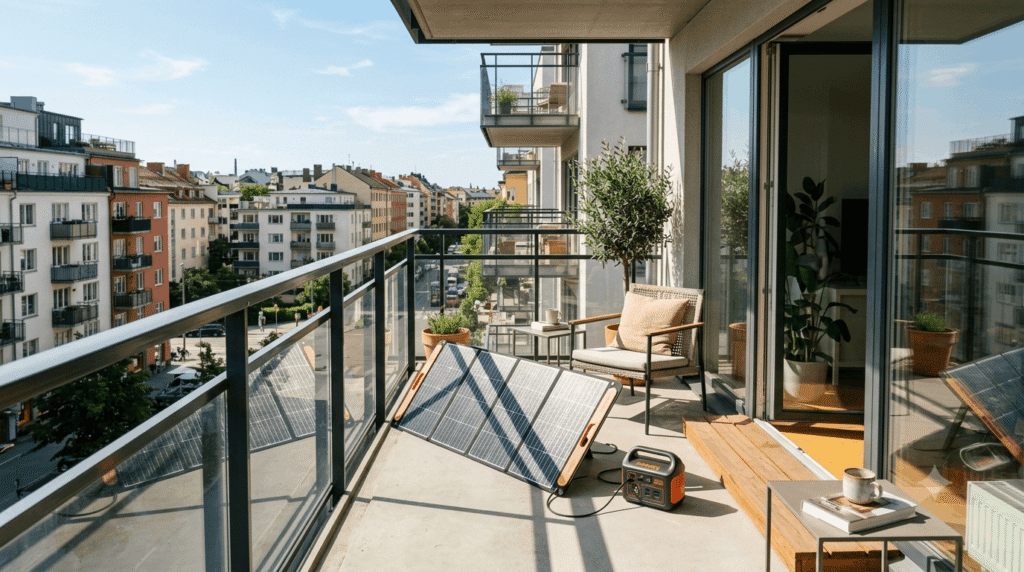
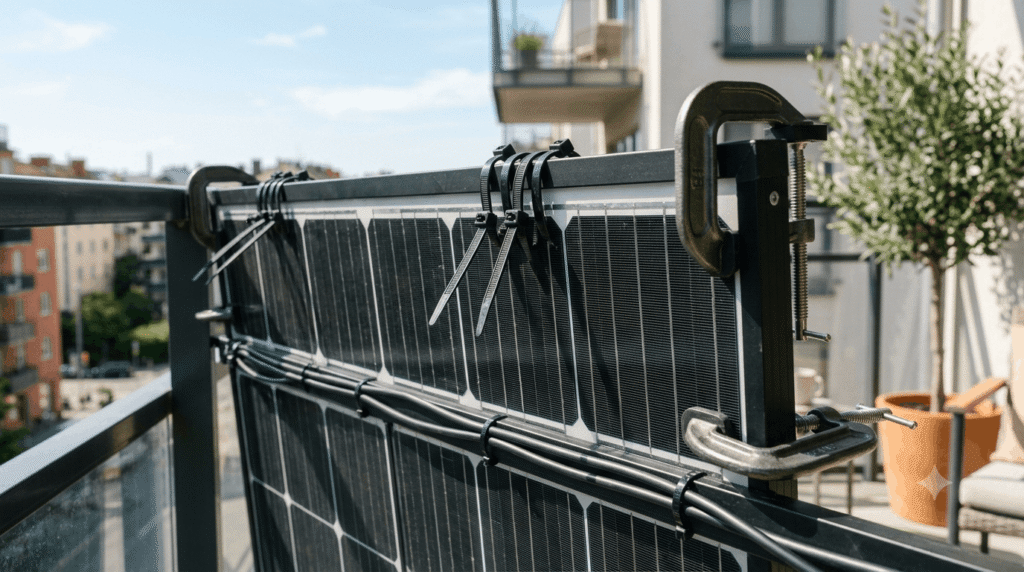
Plug-and-play kits sit on a balcony rail, lean against a fence, or sit flat on a patio. No drilling. No electrician standing in your living room. No permanent anything.
And here's the part renters love most:
Pack it up in a box when you move
Set it up again at the new place in an hour
It's yours, not the building's
You get 100% asset retention. That solar panel follows you from apartment to apartment, the same way your microwave does.
Verified fact: In the UK, a new law called SI 2026 No.848 comes into force on 27 August 2026. It'll legally allow plug-in balcony solar through a standard 13A socket, up to 800W AC. But here's the catch: no certified kit has actually made it to market yet, and you'll still need your landlord's permission before you plug anything in.
Here's how it breaks down on each side of the Atlantic.
Homeowners associations (HOAs) can't blanket-ban solar in a growing number of states, but the rules were mostly written with rooftop systems in mind, not balcony kits
Look for a kit certified to UL 3700. That's the actual US safety standard built specifically for plug-in solar, and it's how you know a kit won't overload your home's wiring
Any kit you connect has to follow G98 grid rules, which cover small generators feeding into the household electricity supply
Setup usually needs a UK 3-pin plug, not the Schuko (European-style) plug you'll see on kits sold in Germany or elsewhere in Europe — check the plug type before you buy
UK caveat, and this one's important: kits that include a built-in battery are not covered under this law. The new rules apply to solar-only setups. If a kit bundles in battery storage, it doesn't qualify for the plug-in route yet.
Here's how it works: a couple of panels, a small microinverter, and a plug that goes straight into your wall socket.
That's it. No junction box on the roof. No electrician wiring it into your consumer unit.
Best for: balconies facing south or west. Those get the most direct sun during the day, which means your panels actually produce something worth talking about.
Verified fact: Before 27 August 2026, the UK still requires a qualified electrician for a hardwired BS 7671 connection. The plug-in socket route only becomes legal after that date, and even then, only for solar-only kits. Battery-bundled kits still don't qualify.
So if you're in the UK and buying before that date, budget for an electrician. After it, check the kit is certified before you plug anything in.
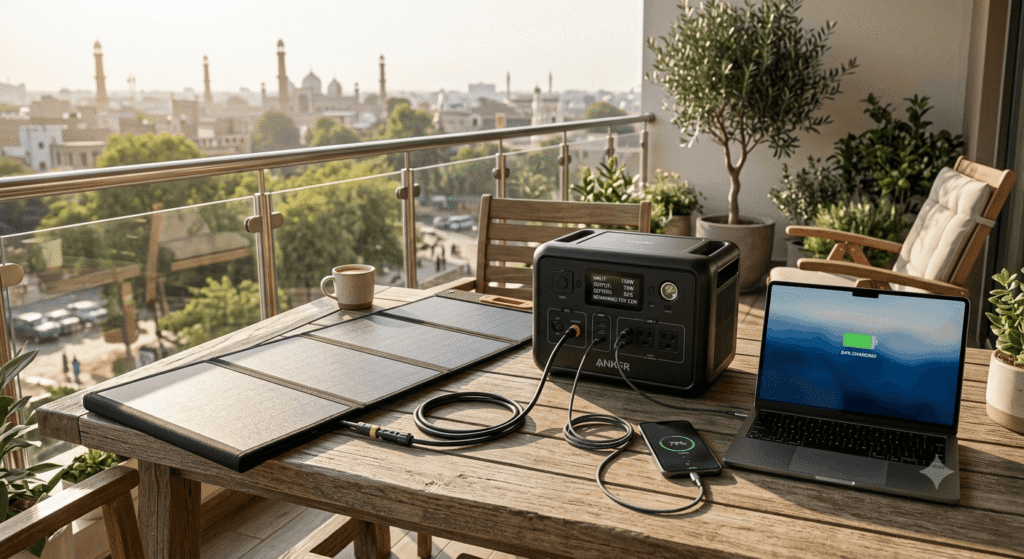
Think of this as a battery on wheels, paired with a panel you unfold and point at the sun.
No wall socket needed
No installation, period
Charges during the day, powers your stuff at night
Best for: people who want zero installation, camping trips, or just backup power when the electricity goes out. You charge it, you use it, you fold it up when you're done.
This is solar at its smallest. A 20W to 60W panel, small enough to clip onto a bag or prop up on a windowsill.
It won't run your fridge. It'll keep your phone, tablet, or a small power bank topped up.
Best for: studio apartments, students, or anyone on a tight budget who just wants to try solar without spending much.
It's the cheapest way in. Start here if you're not sure solar is even for you yet.
This is the serious option. A battery of 1kWh or more, paired with 200W to 400W of panels.
Enough to actually matter during a blackout.
Best for: running a mini-fridge, a CPAP machine, or a small home office setup when the power's out. If you've ever lost a fridge full of food during an outage, this is the one that fixes that problem.
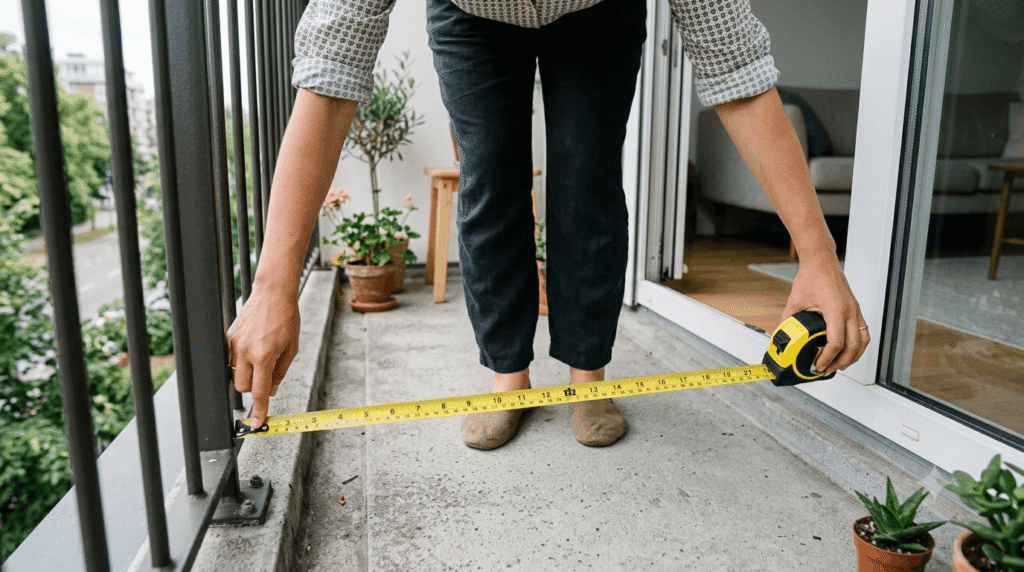
Before you buy anything, ask one simple question: where's this actually going to sit?
A balcony that's 3 feet wide can't fit an 800W setup with two big panels. Measure your space first, not after the box arrives.
Weight matters too. Some panels are light enough to lean against a railing. Others need real support behind them.
Measure your balcony or patio space before you shop
Check the panel weight, not just the wattage
Think about storage too — where does it live when it rains?
The whole point of this guide is no drilling. So here's what actually holds a panel up without touching the wall or railing:
Zip ties — cheap, fast, works on most railings
Railing clamps — sturdier, reusable, no marks left behind
Suction mounts — great for glass balconies or smooth surfaces
Pick based on what your balcony is actually made of. Metal railing? Clamps work great. Glass panel? Suction mounts are your friend.
This is a real decision, not just a spec sheet detail.
Direct power use means your panel feeds power straight into your home while the sun's out. Simple. Cheaper. But once the sun goes down, you're back on grid power.
Battery storage means you store the extra power and use it later — at night, or during an outage.
Direct use is fine if you just want to shave a bit off your daytime bill. Battery storage makes sense if outages worry you, or you want power after dark.
Verified fact: The US runs on 110V. The UK runs on 230V. Buy a kit built for the wrong region, and you can damage your inverter — sometimes on day one.
This isn't a small detail. It's the difference between a working setup and a fried one.
Always check the voltage rating before you buy
Don't assume a kit from a US site works in the UK, or the other way round
If you're importing a kit, double-check the plug type and voltage match your country
One wrong click on "buy now" and you could be out the full cost of the kit.
This is the one most reviewers keep landing on, and for good reason.
The DELTA 2 packs 1,024Wh into a unit with 1,800W output, running on LFP battery cells rated for 3,000+ cycles. It charges to 80% in about 80 minutes, and EcoFlow backs it with a 5-year warranty — longer than most competitors offer.
Want something lighter? The River 2 Pro sits at 768Wh with 800W output, and it's noticeably easier to carry around.
Balance of capacity, speed, and warranty length
Solar input maxes at 500W, so it charges fast with the right panels
Good pick if you want one unit that does almost everything
Jackery built its name on being simple to set up, and that hasn't changed.
The Explorer 1000 Plus holds 1,264Wh and puts out 2,000W, enough to run 99% of household devices. Pair it with SolarSaga 200W panels and you're looking at a full recharge in around 2 hours of good sun.
Straightforward setup, minimal learning curve
Expandable with add-on battery packs if you need more capacity later
A solid first purchase if you've never touched solar gear before
If you just need panels, not a whole ecosystem, this is where to start.
The 200W blanket folds down to backpack size, weighs under 9 lbs, and works with most power stations on the market, not just Renogy's own. It's IP65-rated, so light rain won't ruin your day.
Cheapest way to add real wattage to an existing power station
Works across brands with the right adapter cable
Great if you already own a battery and just need panels
This one's built for people who actually worry about the power going out.
The AC200L holds 2,048Wh and supports up to 2,400W output, with expansion batteries that push total capacity as high as 7kWh. Six different charging methods are supported at once, including solar and wall power together.
Best pick if you want real blackout coverage, not just a phone charger
Heavy at over 50 lbs, so this stays in one spot rather than traveling with you
Expandable if your power needs grow later
This is solar you can throw in a backpack and forget about until you need it.
The BigBlue 28W panel weighs under 1.5 lbs and plugs straight into your phone or a power bank through USB. Anker's Solix PS30 runs a bit higher at 30W with USB-C fast charging built in.
No battery, no bulk — just direct sun-to-device charging
Perfect for students or anyone who just wants a backup phone charger
Cheapest entry point into solar, full stop
Here's an option a lot of renters don't even know exists: you don't need any hardware at all.
Community solar works like this — you subscribe to a share of a solar farm somewhere in your area. You don't install anything. You don't touch a panel. You just sign up.
Every month, your utility bill gets a credit based on your share of that farm's output.
Typical savings: 5% to 15% off your electric bill
No panels, no roof, no installation
Available in over 24 states now, and growing
It's basically the closest thing to "set it and forget it" solar. You pick a provider, sign a contract (usually 12 to 25 months), and the savings just show up on your bill automatically.
One thing worth checking: contract length and cancellation terms vary a lot by provider. Read that part before you sign anything.
The UK version of this works a bit differently, and it's worth understanding both pieces.
Local green energy co-ops let you invest in or subscribe to community-owned renewable projects — wind, solar, or a mix. You put money in, and you get a return, sometimes as a bill discount, sometimes as a small dividend, depending on the co-op.
But here's where it gets a bit more complicated:
The Smart Export Guarantee (SEG) is a separate scheme. It pays homeowners for solar power exported to the grid, usually 5p to 15p per kWh.
SEG only applies if you have your own MCS-certified solar installation — which means it's built for homeowners with panels, not renters without any hardware.
So for most renters, the co-op route (not SEG directly) is the realistic path in.
Bottom line: if you're renting in the UK and want in on renewable energy without any equipment, look for a local co-op near you rather than trying to register for SEG yourself. SEG becomes relevant later, if you ever end up with your own certified system.
Let's talk numbers, because that's what actually decides whether you buy or skip this.
Solar for renters comes in three price tiers, and each one does a different job:
USB solar chargers: $50 — just keeps your phone topped up
Balcony solar kits: $200–$400 — chips away at your daily electric bill
Full portable generators: $800–$1,200+ — real backup power when things go wrong
Start small if you're not sure. A $50 charger tells you almost nothing is at risk. Jumping straight to a $1,200 generator without trying solar first is a bigger leap than most people need to make.
💡Verified fact: An 800W balcony kit typically generates around 700–800 kWh a year in the UK, depending on how sunny your location is and which way your balcony faces. With realistic self-consumption of 50–60% (no battery), that works out to roughly £120–£210 a year in savings. Payback on a £600–£800 kit lands around 3–4 years, not 5–10 — add a battery and your self-consumption climbs higher, but the kit costs more upfront too.
A few things move that number around:
Facing direction matters a lot. South-facing balconies generate the most. North-facing loses 30–40% of that output.
Timing your usage helps. Running your washing machine or charging devices during daylight hours instead of at night boosts how much solar power you actually use, instead of exporting it for pennies.
A small battery changes the math. It costs more upfront (£350–£680), but pushes self-consumption from around 50% up to 80-90%.
Here's the number that rooftop solar just can't compete with: 100%.That's how much of your investment you keep when you move out. A rooftop system stays behind. Every penny of it. You paid for it, your landlord (or the next tenant) benefits from it.
Portable solar doesn't work that way.
Pack it. Move it. Set it up again.
No sunk cost left behind in an apartment you don't live in anymore
Your $400 kit is still worth $400, wherever you end up living next
That's the real financial edge for renters. It's not just that portable solar is cheaper upfront. It's that every dollar you spend actually stays yours.
Read your lease first. Actually read it, not skim it. Look for anything about exterior modifications or "hanging items" on railings.
Then check which way your balcony faces. South or west is what you want. That's where the sun actually sits for most of the day.
Spend a day watching your balcony. Note when the sun hits it and when it doesn't. 💡Verified fact: Placing a panel behind glass — a window, a glazed balcony door — cuts its output by roughly 40% to 60% compared to direct outdoor placement. With Low-E coated glass, that loss can climb to 70% or more. Always put the panel outside, in direct air, not behind glass.
Four or more hours of direct sun is a good target. Less than that, and even a good kit will underperform.
Before you buy anything, add up what you actually want to power.
A router and a few lamps? A small kit covers that.
A mini-fridge or a CPAP machine? You need real capacity, not just a USB charger.
Whole-apartment backup during outages? Now you're looking at a full generator setup.
Match the kit to the job. Buying more than you need just wastes money. Buying less means it won't do what you actually bought it for.
This decision comes down to timing.
Panel only works while the sun's out. Once it sets, you're back on grid power.
Panel + power station stores extra energy, so you get power after dark, or during an outage.
If you're just trying to shave a bit off your daytime bill, panel only is fine. If you want backup power too, you need the battery in the mix.
This one gets skipped a lot, and it shouldn't.
Check the return window before you buy, not after it arrives
Confirm the warranty actually applies in your country — some kits are region-locked
Save your receipt and the box, just in case
A good kit with no return options is a bigger risk than a decent kit with an easy 30-day return. Don't skip this step just because you're excited to plug something in.
Here's the fastest way to figure out what fits your situation:
Sunny balcony + want lower bills? → Plug-in balcony solar
Need emergency backup + want to move it around? → Portable power station bundle
Want zero equipment, zero effort? → Community solar subscription
Tight budget + studio apartment? → Foldable USB solar panel + power bank
No overthinking needed. Match your situation to the list, and you've basically made your decision.
Verified fact: Right now, before 27 August 2026, the best legal option for UK renters is a portable power station + foldable panel combo. Why? Because certified plug-in balcony kits simply don't exist on the market yet. After that date, once compliant 800W balcony kits are certified and available, that becomes the better value pick for most renters.
So here's the honest advice: don't wait around for the "perfect" solution.
A power station + foldable panel works today, no legal grey area, no waiting on certification
It's fully portable, so nothing changes if you move house before August
Once certified balcony kits hit shelves, you can always add one later, or switch entirely
Start with what actually works right now. Upgrade later if the balcony route makes more sense once it's properly legal and certified. Either way, you don't need to own a roof to start saving money and taking control of your own power.
Disclaimer: This post contains affiliate links. If you make a purchase through these links, I may earn a small commission at no extra cost to you. I only recommend products I truly believe in.
Pingback: Best Solar Generator for Apartments in 2026 (USA & UK guide
Pingback: My Landlord Said No to Solar Panels — What I Did Instead