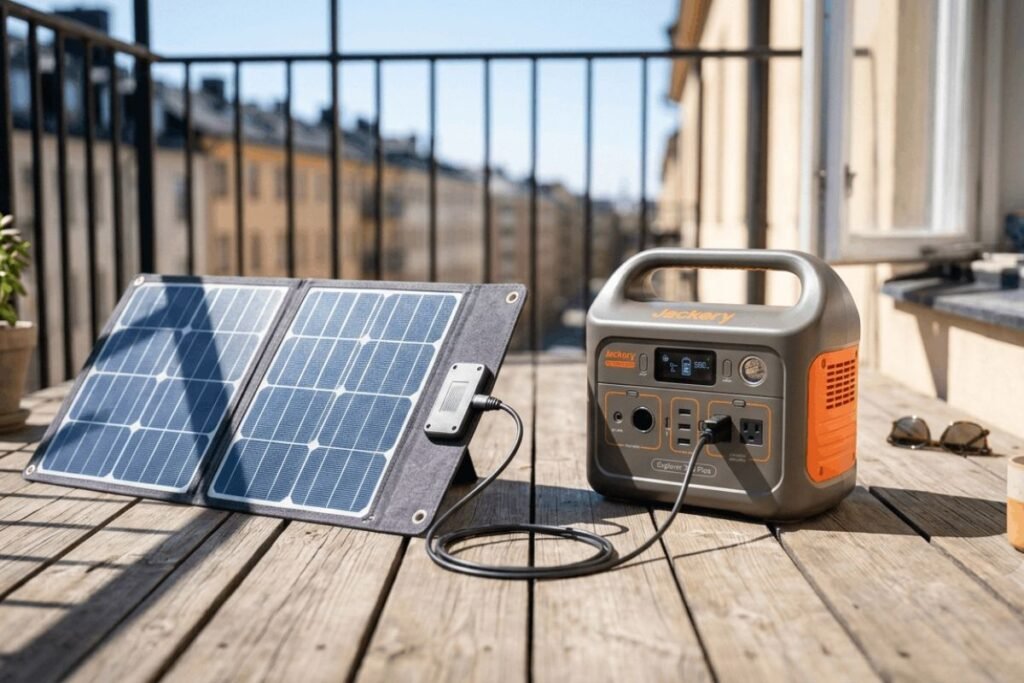
I still remember typing that message.
"Hey, would it be okay if I put a small solar panel on the balcony?"
Simple question, right? I thought so too. In my head, I'd already pictured it working out. Maybe a quick "sure, no problem" text back. Maybe even a "oh that's cool, let me know how it goes."
That's not what happened.
My landlord called me back within the hour. And within thirty seconds of the call, I knew where this was going.
"I'd rather you didn't touch anything on the balcony structure," he said. Then came the real reason. "If something happens with the wiring or it damages the railing, that's on me, not you. Insurance doesn't cover stuff like that."
I tried to explain it was just a small panel, nothing permanent. He wasn't budging.
"Sorry, it's just not something we allow here."
And that was that. Conversation over, hopes deflated.
Here's the thing though. This isn't going to turn into a "woe is me, my landlord ruined my dreams" post. Not even close.
What I'm about to walk you through is exactly what I did after that call. Every option I tried, what actually worked, and what I'd do differently if I could go back and skip a few wasted steps.
Okay, so the answer was no. Fine.
But here's what I realized pretty quickly — that "no" wasn't actually about solar power. It was about permanent installation. Two very different things.
My landlord wasn't saying "you can't have solar energy in your apartment." He was saying "you can't drill into my building." Big difference, and honestly, one I hadn't even considered before that call.
So instead of dropping the whole idea, I just... redirected. Started looking at what else was out there.
Here's what this article is going to cover:
What I actually tried first (and why it kind of flopped)The setup that finally worked, with zero permission needed
What it costs, what it saves, and whether it was actually worth it
What I'd tell you to do differently if you're starting from scratch
If you're in the same boat, stuck with a landlord who said no, stick around. This isn't theory. This is what actually happened when I figured it out myself.
Curious about other renter-friendly solar options before we get into my story? → Best Renter-Friendly Solar Options & Portable Kits in 2026
After that phone call, I actually sat down and thought about it. Why would someone say no to something that doesn't cost them a thing?
Turns out, there are real reasons. Not just landlords being difficult for no reason.
Roof and railing liability. If something goes wrong, a leak, a crack, loose wiring, it's the landlord's name on the property, not yours. That's a risk they didn't sign up for.
Insurance headaches. Most standard property insurance doesn't cover damage caused by tenant modifications. So if a panel falls or causes an issue, the landlord could be stuck paying out of pocket.
Drilling equals damage. Even a small hole for mounting brackets or cable routing counts as permanent alteration. And permanent alteration usually means a fight over your security deposit, or worse, a legal headache for them.
Zero financial upside for them. Here's the part that really clicked for me. I'm the one paying the electricity bill, not my landlord. So installing solar saves me money, not him. Why would he take on risk for a benefit he never sees?
It's not personal. Honestly, once I understood all this, I stopped feeling annoyed. It wasn't about me. It was just standard risk management. Most landlords would say no to almost anyone asking the same thing.
Made sense once I laid it out like that. Frustrating, sure. But not exactly unreasonable.
Okay, so here's where my brain had to do a little shift.
Anything involving tools, drills, or permanent mounting? Off the table. Completely.
That ruled out actual rooftop panels obviously. But it also ruled out a bunch of "renter-friendly" solar kits I found online that still needed screws or brackets.
So I changed the question I was asking myself.
Instead of "how do I install solar," I started asking "how do I get solar power without installing anything at all."
That one shift in thinking is honestly what led me to the setup I ended up using. More on that coming up, including the version I tried first that didn't really work out.
So naturally, I did what most people do. I went straight to Amazon and searched "solar charger."
Found this little folding panel, maybe $30, with decent reviews. Looked legit enough. I figured, why not start small and see how it goes.
Big mistake in my thinking, actually. Not the purchase itself, the expectation.
In my head, I pictured charging my phone during the day, maybe running a small fan at night, all off this one tiny panel. Basically imagining it as a mini power station.
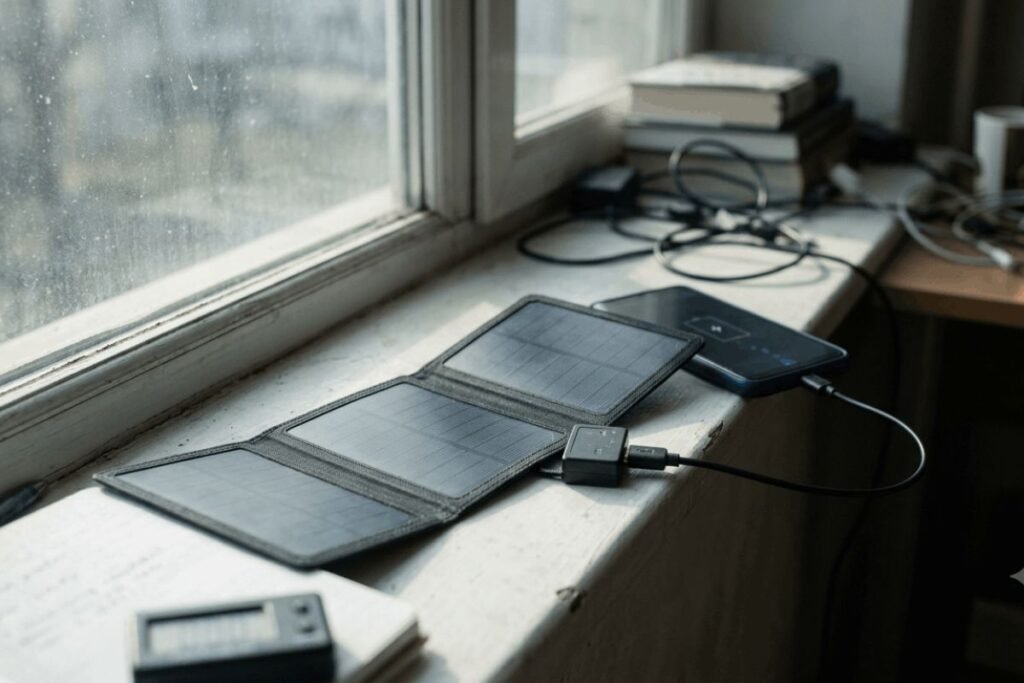
It arrived. I unfolded it on my windowsill. Plugged in my phone.
It worked, technically. Charged my phone. Slowly. On a good sunny day, if I left it out for hours.
But that was it. That's all it could do. One phone, slow charge, sunny days only.
No fan. No laptop. Definitely nothing bigger.
Honestly, I felt a little silly. I'd built this whole picture in my head of backup power for blackouts, and what I actually had was a glorified phone charger that needed direct sunlight and patience.
Here's what I didn't understand back then, and I think a lot of people don't either.
A small solar panel and a "solar generator" sound similar. They're really not the same thing at all.
That $30 panel I bought? It has no battery. Zero storage. It only works while the sun is actually hitting it, and only for whatever's plugged in right at that moment.
A solar generator is different. It's basically a battery, a proper one, that stores power. You charge it up during the day, then use that stored power whenever you actually need it, day or night, rain or shine.
Once that clicked for me, everything changed.
I stopped browsing random $20-30 gadgets and started actually researching. Battery capacity, output wattage, what devices I actually wanted to run, all of it.
Took a bit more time upfront, sure. But it saved me from buying three more cheap disappointments before landing on something that actually worked for my apartment.
After the phone charger disappointment, I did my homework properly this time.
I ended up going with a portable power station. Around 768Wh capacity, enough to cover my daily essentials without going overboard on price. Paired it with a foldable solar panel to charge it up.
Why that capacity specifically? Well, I sat down and actually thought about what I needed to run. Router, laptop, some lights, a fan. Not a fridge, not AC. So I didn't need some massive, expensive unit built for a whole house.
Here's the part I loved most though.
Zero permits. No landlord conversation needed, not even a heads up really. Nothing gets drilled, nothing gets mounted permanently. If I move out tomorrow, I just unplug everything and take it with me.
That's the whole point of going portable. You get the backup power without any of the property drama.
Before you decide, it helps to see the difference side by side. Here's roughly how it breaks down:
Basically, if you've got even a little outdoor space, adding the panel pays for itself over time since you're not always pulling from the grid to recharge. If you genuinely have zero outdoor access, a power station alone still works, you'll just be plugging it into the wall to recharge instead of the sun. I ended up going with a Bluetti AC70 — around 768Wh capacity and EcoFlow River 2 Pro (768Wh, alternative option).
This part surprised me with how simple it actually was.
I placed the foldable panel on my balcony railing, angled toward the sun.
Used zip ties to secure it in place. Living somewhere with occasional strong wind gusts, I wasn't taking chances with it flying off.
Ran a flat ribbon cable from the panel, through the gap under my closed window frame, straight to the power station sitting indoors.
That's genuinely it. No drilling. No damaged window seal. The window still shuts completely fine, cable and all.
Took me maybe twenty minutes total, most of which was just figuring out the best angle for sunlight.
Want the full breakdown of which power station and panel combos work best for apartments? → Best Solar Generator for Apartments in 2026 (USA & UK Buyer's Guide)
Let's get real about what this setup can and can't do. No exaggeration here.
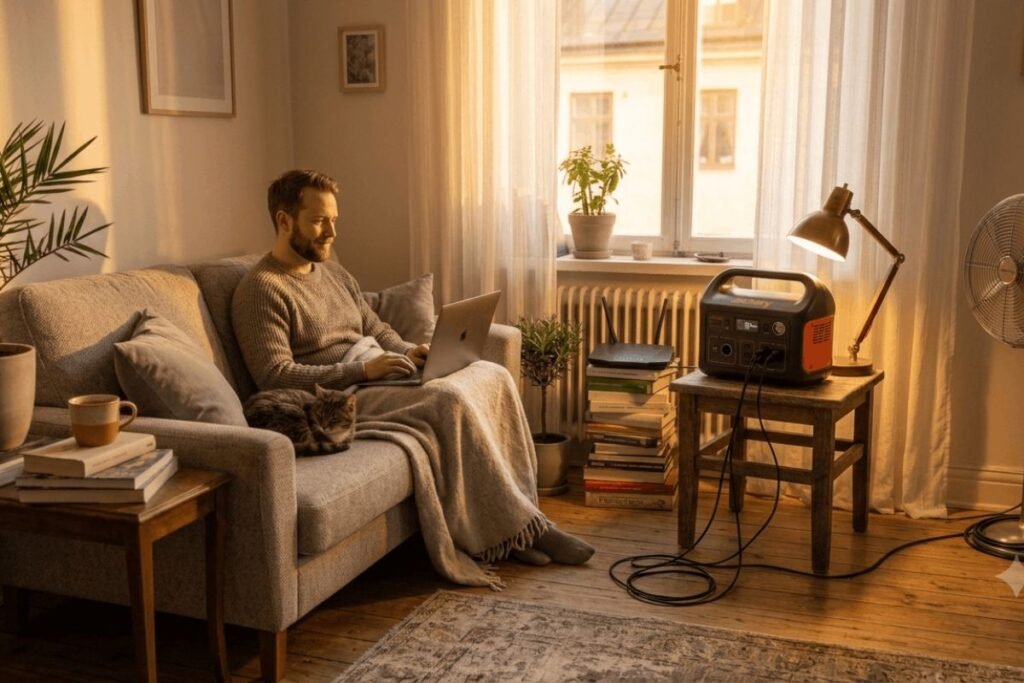
My Wi-Fi router, running constantly
Laptop, charging through work hours
A couple of desk lights in the evening
A standing fan on warm nights
Basically, my normal daily routine runs off this thing without any issue.
Run an AC unit. Not even close, the power draw is way too high.
Power an electric space heater. Same story, heaters pull a ton of wattage.
Run a full-sized fridge continuously. It could handle short bursts, but not all-day operation.
Honestly, I went in expecting these limitations, so nothing here caught me off guard. If your main goal is backup for essentials and daily convenience, this setup nails it. If you're hoping to run your whole apartment during a blackout, you'd need to size up significantly.
Now, I know my setup worked because I had a balcony with decent sun exposure. But what if you don't?
Maybe your apartment faces north. Maybe you've got zero outdoor space at all, just windows that barely see direct light. If that's you, don't worry, you're not out of options.
There's actually a way to benefit from solar without owning a single piece of equipment.
It's called community solar.
Here's how it works, in the simplest terms. Somewhere near you, there's a solar farm, a big field of panels generating clean energy. Instead of installing panels yourself, you subscribe to a small share of that farm's output.
You don't touch any hardware. Nothing gets shipped to your door. Nothing sits on your balcony.
Every month, that solar farm generates power, and you get a credit on your electricity bill for your share of it. Typically, that credit works out to somewhere between 5% and 15% off your normal bill.
It's not going to make your electricity free. But it's consistent savings, month after month, with genuinely zero setup on your end.
Best part? This works even if:
You live in an interior apartment with no windows facing the sun
Your building doesn't allow anything on the balcony, not even non-permanent stuff
You just don't want the hassle of managing physical equipment at all
Basically, if the portable power station and panel route isn't realistic for your space, community solar is worth looking into. Not as hands-on, sure. But it still gets you moving in the right direction without a single tool or drill involved.
Let's talk real numbers. No vague "it's worth it, trust me" stuff.
In my case, the whole setup, power station plus solar panel, ran me right around $450 total. Not pocket change, I'll be honest. It made me pause before clicking buy.
But here's where it gets interesting.
Since I started using it, I've noticed my monthly electric bill drop by roughly 15-20%. Mostly from not pulling grid power for my daily essentials, router, laptop, lights, fan, all of that.
Doing the math on that, my payback period lands somewhere around 2 to 3 years. After that point, it's just pure savings, month after month, for years to come.
Now, I'm not saying you'll see the exact same numbers. Your electricity rate might be higher or lower than mine. Your usage habits are different too. But the pattern holds true, small upfront cost, steady savings that add up over time.
Here's the thing though, don't just take my word for it. Your situation isn't my situation.
Your local kWh rate matters a lot here. If you're paying more per kWh than I am, your savings could actually be bigger than mine. If you're paying less, the payback might stretch out a bit longer.
Grab your last electric bill, find your rate per kWh, and just run the numbers for your specific case.
Want to skip the manual math? I built a tool for exactly this. Plug in your numbers and see your real payback period → Free Solar ROI Calculator
And if you're still on the fence about whether solar even makes financial sense this year, especially with all the tax credit changes, I broke that down separately too.
Curious how the numbers look without the old tax credit? → Is Solar Still Worth It in 2026 Without the Tax Credit?
Okay, here's my biggest "I wish I knew this sooner" moment.
Remember that awkward phone call at the very start? The one where my landlord said no?
Looking back, I honestly didn't need to make that call at all.
A fully portable setup, power station, foldable panel, zip ties, doesn't require permission. Nothing gets installed. Nothing gets modified. It's no different than owning a lamp or a laptop, really.
If I'd known that going in, I could've skipped the whole conversation and just... started. No waiting around, no awkward rejection, no weeks lost overthinking it.
So here's the lesson for you. If your setup is genuinely portable, nothing drilled, nothing permanent, you don't owe your landlord a heads up. Just go for it.
Save the phone calls for things that actually need permission.
Second thing I'd tell my past self, don't go big right away.
I almost bought a massive, expensive power station on day one. The kind built to run half an apartment. Glad I didn't.
Why? Because I genuinely didn't know my actual usage yet. Turns out my daily needs were way smaller than I thought.
Better approach, start with something modest, learn your real patterns for a few weeks, then upgrade if you actually need to.
Before you buy anything, run through this quick checklist:
Check your space. Balcony, window ledge, or nothing at all? This decides whether solar charging is even realistic for you.
Track your actual daily wattage needs. List what you truly want backed up, router, laptop, lights, fan. Add up rough wattage before assuming you need something huge.
Set a real budget boundary. Decide your ceiling before browsing. It's way too easy to get talked into paying for capacity you'll never use.
Start smaller than you think you need. You can always add a second panel or bigger unit later. Downsizing after overspending? Not so easy.
Trust me, starting small saved me from a much bigger, unnecessary expense. Learn your habits first, then invest based on what you actually use, not what sounds impressive on a spec sheet.
Looking back at that phone call now, it almost makes me laugh a little.
I remember hanging up feeling stuck. Like the whole idea was dead before it even started.
But here I am, months later, with a setup that quietly powers my daily essentials. No permits. No landlord drama. No permanent changes to an apartment that isn't even mine.
That "no" I got wasn't actually a dead end. It just pushed me toward something better suited for renters anyway, something portable, flexible, and completely mine to take wherever I go next.
If you're renting and hit the same wall I did, don't read it as rejection. Read it as a redirect. There's a whole path here that doesn't need anyone's permission but your own.
So that's my story, start to finish. The awkward call, the cheap gadget mistake, and finally, the setup that actually worked.
Now I'm curious about yours. Have you tried something similar? Hit a wall with your landlord too? Drop a comment, I'd genuinely love to hear how you worked around it.
And if you're ready to pick out your own setup, don't just guess at sizing like I almost did. Go check out the full breakdown of options based on your actual apartment space and daily needs.
Find the exact power station size for your space → Best Solar Generator for Apartments in 2026 (USA & UK Buyer's Guide)
Disclaimer: This post contains affiliate links. If you make a purchase through these links, I may earn a small commission at no extra cost to you. I only recommend products I truly believe in.