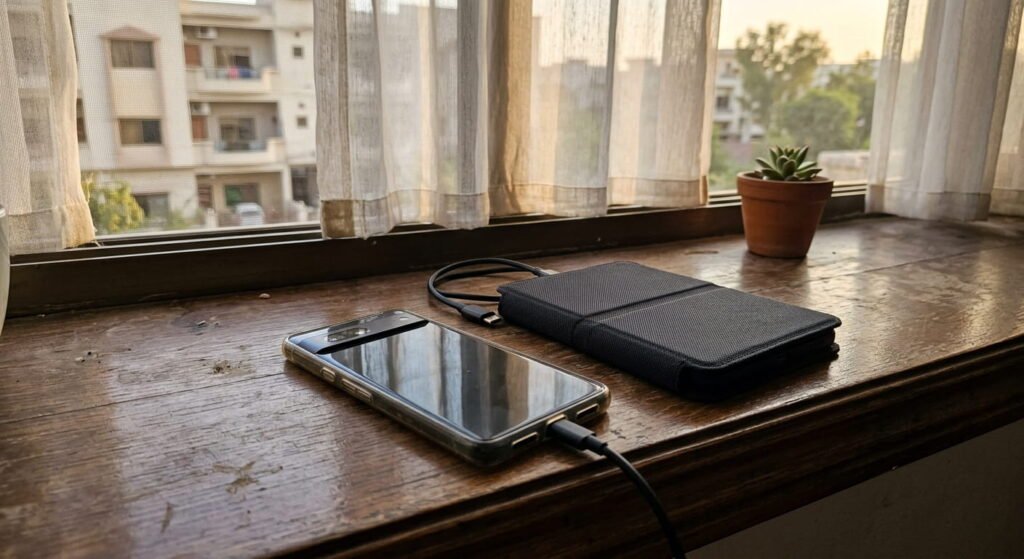
My landlord's rules are simple. No nails, no anchors, no drilling into anything.[I've written before about how I worked around this exact problem when my landlord said no to solar panels altogether.] I get it. It's an old building and he doesn't want holes in the walls every time a tenant moves out. But it means my options for setting up anything permanent are basically zero. I've hung curtains with tension rods and stuck shelves up with Command strips, and that's about the extent of what I'm allowed to do.
Then my electric bill showed up one month at almost sixty dollars higher than usual, and I sat there staring at it wondering what on earth I'd been running. Turns out it was a mix of things. The AC working overtime in July, sure, but also just how many devices I keep plugged in and charging around the clock. My phone, my laptop, a tablet I barely use but still charge out of habit, a portable speaker, my kid's old Nintendo Switch. It adds up in ways you don't notice until the bill lands.
I started looking into solar chargers almost as a joke. I pictured big panels strapped to a roof, which obviously wasn't happening in a rented apartment on the third floor. But it turns out portable solar chargers have gotten a lot smaller and a lot more capable than I expected, and a few of them are the same models outdoor sites and gear reviewers keep recommending for camping and backpacking. If they can charge a phone off-grid in the middle of nowhere, I figured, surely one could handle my window.

I have exactly one window that gets real sun, a south-facing one in my living room that catches light from around ten in the morning until early afternoon. Everything else in my apartment either faces a brick wall or gets maybe twenty minutes of direct light before a neighboring building blocks it out completely. So this window was always going to be the test site, no other real contenders.
Here's what I didn't account for going in. A window is not the same as being outside. There's glass in the way, for one, and glass cuts down on how much light actually reaches a solar panel, even when it looks bright out. My window also has a screen, which I didn't think twice about until I started reading how much extra shade a screen can throw. And then there's the angle. Panels are supposed to face the sun as directly as possible, but a panel taped or propped against a vertical window is sitting at basically the worst angle you could give it for most of the day.
So going into the actual test, I lowered my expectations. This wasn't going to replicate a rooftop or a campsite. The real question was whether it could still pull enough power to be worth the trouble in an apartment where drilling anything into the wall simply isn't an option.
I didn't think glass would matter that much. It's clear, right? Light goes through it, end of story. Except that's not really how it works. Regular window glass blocks a decent chunk of the light spectrum that solar panels actually rely on. Not all of it. Just enough to matter...glass cuts down on how much light actually reaches a solar panel... The U.S. Department of Energy explains how photovoltaic cells actually convert sunlight into usable electricity, which helped me understand why obstacles like glass matter so much.]
I noticed it the first afternoon. Same panel, same sun, same time of day — except I'd stepped out onto my tiny balcony for two minutes to test it there too. The output jumped almost right away. No app, no math needed. The little LED indicator on the charger straight up lit up brighter outside than it did three feet away through the glass.
So that was strike one against the whole "test it from your window" idea. Glass isn't neutral. It's basically a dimmer switch you didn't ask for.
Here's the thing about most solar charger reviews, including the ones from Wirecutter and similar sites. They test these panels the way they're meant to be used. Propped up with a kickstand. Clipped to a backpack at an angle. Laid flat on the ground, tilted toward the sun, adjusted every hour or two as the sun moves.
None of that is realistic in a rental. I don't have a yard. I don't have a balcony railing I'm allowed to drill into. What I have is a window, some painter's tape, and maybe a stack of books if I get creative. That's it.
So my panel sat pretty much straight up and down the whole time, facing whatever angle the window happened to be at. Not the panel's fault. Just physics doing its thing. A flat vertical surface catching indirect light is never going to perform like a panel angled straight at the sun. The gear reviewers aren't wrong about their numbers. Their setup is just a different world than mine.
Every charger I tested had a number on the box. 20 watts. 28 watts. One even said 60. Big, bold, confident numbers. I'll be honest, those numbers got my hopes up a little.
But that number is a best-case figure. It's what the panel puts out in full, direct, unobstructed sunlight, hitting it at close to a perfect angle. Basically lab conditions, or the outdoor equivalent of them. My apartment window offered none of that. Add the glass, add the bad angle, add the fact that my window only gets strong light for a few hours a day, and that "28 watts" panel was giving me a fraction of what the label promised.
It's not false advertising. It's just a number measured somewhere very different from where I live. Once I stopped expecting the box number and started just watching what the charger actually delivered in real time, the whole test made a lot more sense.
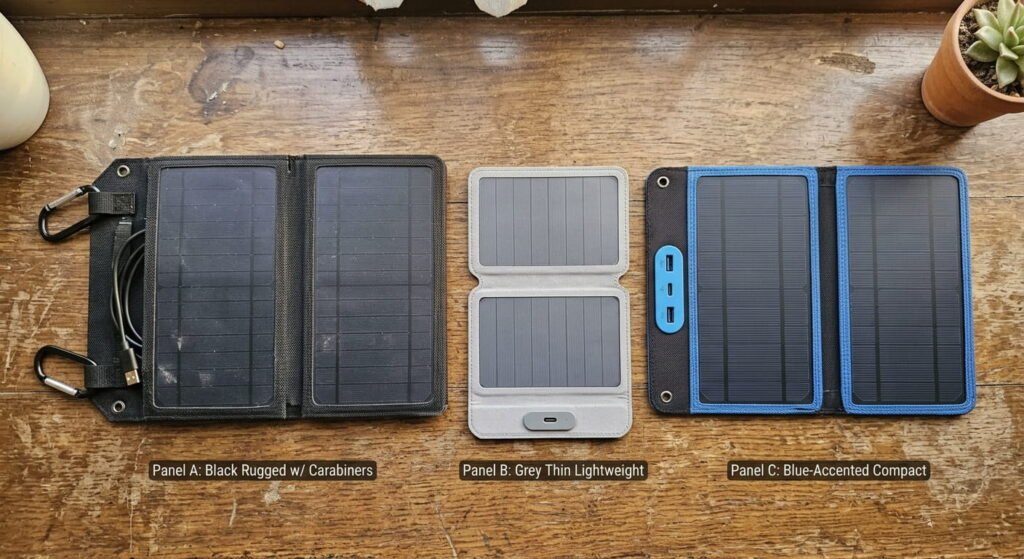
Quick disclosure here too. This one isn't a Wirecutter pick either. I included it because it's one of the more commonly recommended solar chargers online, and it's built almost identically to the BigBlue — same dual-USB setup, same foldable canvas design, no built-in battery.
Propped against my windowsill, it performed close to the other two. I leaned it upright against the glass, angled slightly with a couple of books behind it, same setup every time. During the strongest light hours, it kept a steady trickle going into my phone. Nothing that set it apart in either direction.
If BigBlue isn't available where you're shopping, this is a reasonable stand-in.....a few of them are the same models outdoor sites and gear reviewers keep recommending. [If you want the full roundup of renter-friendly picks, I've covered more portable kits here.]
One thing worth flagging — neither of these two store power. Both work the same way: real-time charging only, while the panel is actually catching light. So if your sunny hours don't line up with when you actually need to charge something, this won't help you bridge that gap.
Nekteck 21W Solar Charger [Check current price on Amazon →]
This one's the lighter, cheaper option, and honestly, it felt like it was made for a setup like mine. It folds down small. It's not heavy. And because it's thinner than Nektech, it actually sat more flush against my narrow windowsill without sliding around every time I bumped the table.
The real test came down to weather. On a fully sunny afternoon, it charged at a pace close to what a slow wall charger would do — slow, but usable. Then a cloudy day rolled in, and the difference was obvious. Output dropped hard. It didn't stop working completely, but it went from "actually charging my phone" to "barely keeping up with the battery just sitting idle." That gap between sunny and cloudy days was bigger than I expected going in...it added a meaningful chunk of battery without me touching a wall outlet once. [Check current price on Amazon →]
I started the test on two days that just happened to be grey and flat, sky-wise. No real sun anywhere, more of that dull white light you get when clouds cover everything evenly. I set all three chargers up on a second window in my place, one that faces north and barely gets direct light even on a clear day.
Results were rough. Genuinely rough. The Nekteck barely registered any movement on my phone's battery percentage over a full afternoon. The BigBlue did a little better, maybe two or three percent gained across several hours. Honestly, on these two days, none of them felt worth the effort. I could've just left my phone plugged into the wall for twenty minutes and gotten more out of it.
It was a useful gut check, though. This is the setup most renters will actually deal with half the year — bad weather, wrong-facing window, low expectations required.
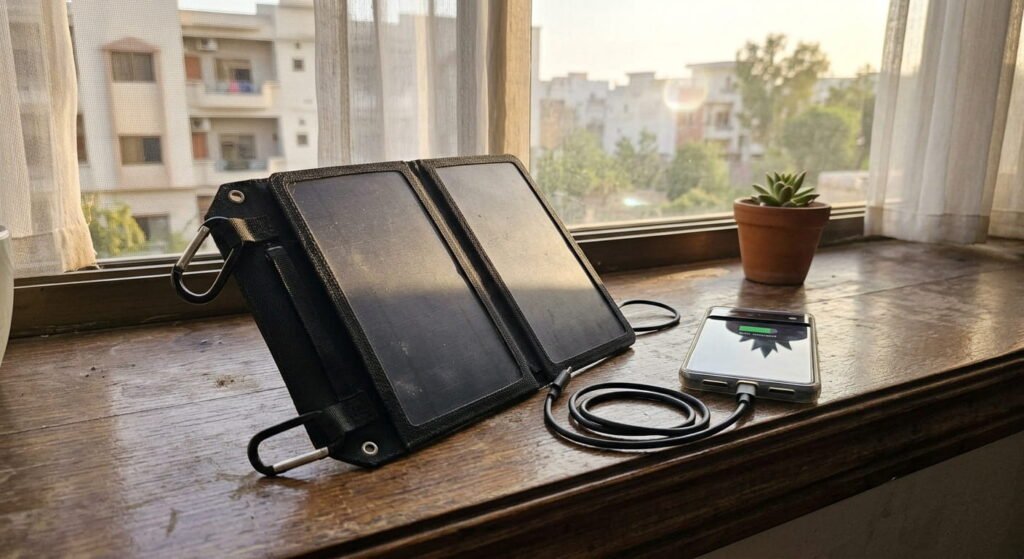
Then the weather turned, and I moved everything back to my good window, the south-facing one with real light. Three days of proper sun, minimal clouds, and suddenly the whole test felt different.
The Nekteck picked up noticeably. Over roughly three hours of strong midday light, it added around 15 to 18 percent to my phone's battery, depending on the day. The BigBlue came close behind it, landing around 12 to 15 percent in that same window.
Nothing here beat a wall outlet. Nothing was ever going to. But this was the first time the whole experiment felt like it was doing something real instead of just sitting there for show.
Breaking it down by hour made the differences a lot clearer than just watching the day as a whole. On the brightest hour of testing, usually somewhere around noon to one o'clock, the Nekteck averaged close to 6 percent battery gain per hour. The BigBlue trailed slightly at around 5 percent in that same hour.
Outside of that peak hour, all three dropped off fast. Early morning and late afternoon hours barely moved the needle, sometimes only 1 to 2 percent an hour, even on the sunny days. So really, the useful charging window each day was short. A couple of strong hours around midday, and everything outside that was more or less a formality.
Going in, I figured this was simple math. Higher wattage panel, faster charge, done. That's basically how it works with wall chargers, so I just assumed solar worked the same way. It doesn't. Not indoors, anyway.
The Nekteck and BigBlue are rated close to each other on paper, but through a window, even that small gap barely showed up. Some hours they were almost neck and neck... A couple of times the BigBlue actually kept pace better, probably because it sat flatter against the sill and caught slightly more direct light at certain angles. The wattage number on the box only means much when the panel is getting close to ideal sunlight. Indoors, through glass, at a bad angle, that number stops being the deciding factor. Positioning mattered more than the spec sheet did.
This one I genuinely didn't think about until I was a few days into testing. My window has a screen, the regular mesh kind most apartments have. I never once considered it would affect anything. It's just a screen. Bugs stay out, air comes in, that's the whole job, right?
Turns out mesh screens block a decent amount of light too, on top of what the glass already cuts. I tested this by accident, really. One afternoon I popped the screen out to clean it and left it out for a few hours while the chargers were running. The difference was small but noticeable, output ticked up slightly compared to earlier readings at the same time of day. Nothing dramatic. But it was one more small loss stacked on top of the glass and the bad angle, and those small losses add up fast when you're already working with limited sunlight to begin with.
If your ledge is narrow, go with the BigBlue. It's the thinnest of the three, folds down small, and doesn't feel like it's about to tip off the sill every time you walk past. My windowsill isn't deep, and this was the only one of the three that actually sat flush without me propping it up against something. For a tight space, that fit matters more than a few extra watts on paper.
If price is the main thing you're watching, the Nekteck is usually the cheaper of the two. It didn't outperform the BigBlue by much..., and on the sunniest hours it kept pace close enough that the difference barely mattered. If you're not trying to squeeze out every last percent of battery and just want something that works without spending a lot, this is the one.
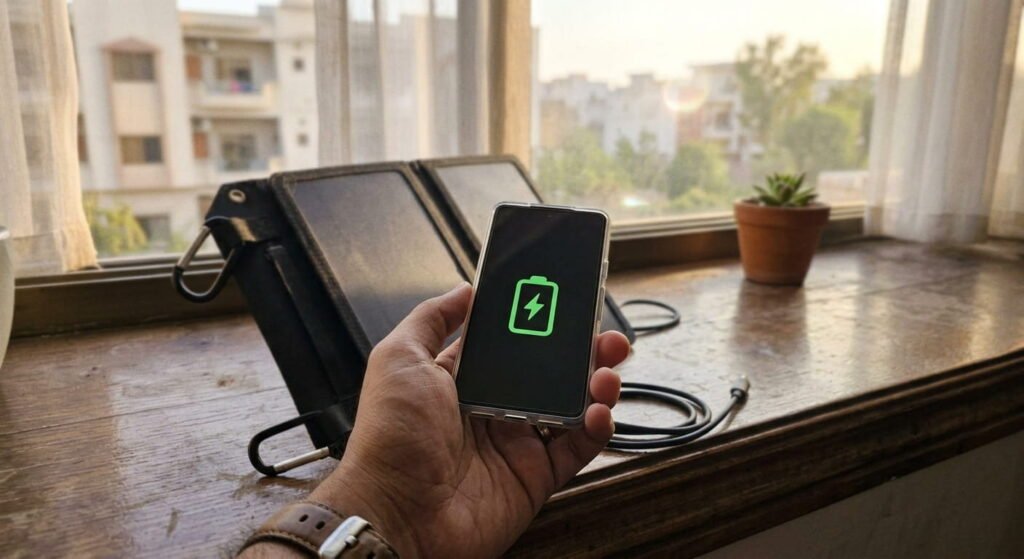
If you'd asked me before this test, I would've said solar chargers were a novelty. Something for campers, not apartment dwellers. Five days in, I don't fully believe that anymore. They're not a replacement for your wall outlet, let's be clear about that. If you need something closer to a real backup power source, I compared a few apartment-friendly solar generators here. But as a small daily habit, propped against a sunny window for a few hours, they genuinely take some load off your regular charging routine.
The BigBlue is my pick for most renters. It's cheap, it fits a small ledge, and it held its own against pricier options more often than I expected. The Nekteck was fine. Just fine. Nothing about it made me want to reach for it over the BigBlue. The BigBlue is my pick for most renters. [See it on Amazon →]
None of these will fix a high electric bill on their own, and that's really what got me looking into this in the first place. It's part of why I started digging into whether solar is even still worth it without the old tax credit. But plugged in on a sunny afternoon instead of an outlet, even for a couple hours, it's a small dent. And in a rental where drilling anything into the wall isn't an option, small dents are sometimes all you get to work with.
Disclaimer: This post contains affiliate links. If you make a purchase through these links, I may earn a small commission at no extra cost to you. I only recommend products I truly believe in.