It’s 2 pm. The sun is pouring through your apartment window, and you stare at the glass and think: why can’t this thing charge my phone?
Here’s the honest answer. The tech is real. Researchers have built see-through solar glass that turns light you can’t even see into power. But you can’t buy it for your rental yet, and you probably won’t be able to for a while.
In this post, I’ll show you how it works, what it costs, and where it stands today. If you’re more interested in what you can actually buy this weekend, I put that in a separate guide on renter-friendly solar options. But I’d read this one first. It’ll save you from wasting money on products that promise more than they can deliver.
What Are Transparent Solar Panels? How They Work in Plain English
A transparent solar panel is a piece of glass or clear plastic that makes electricity. You look through it like a normal window. Meanwhile, it quietly collects power from sunlight you can’t see. Let me explain how that works, without the lab jargon.
The science behind selective light absorption
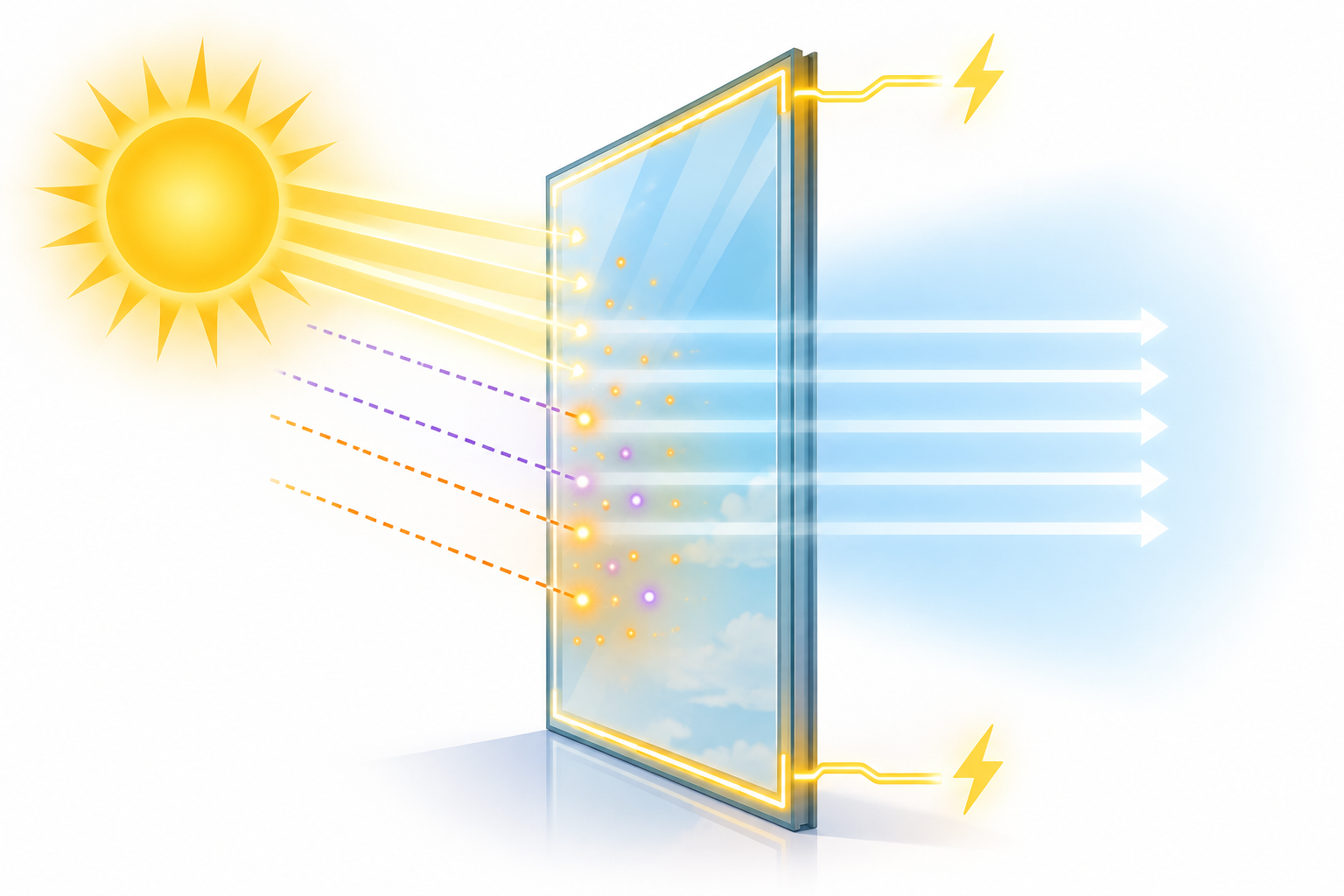
Sunlight isn’t just the light your eyes pick up. It also carries ultraviolet (UV) and infrared (IR) light. You can’t see either one, but both carry energy. Regular solar panels soak up almost everything, which is why they look dark blue or black. Transparent ones are picky.
They let visible light pass through and grab only the UV and infrared. Think of sunglasses that block glare you can’t see while you still see clearly. Same idea, except this glass turns what it blocks into power.
How it works in four simple steps
First, sunlight hits the glass. Second, a special coating or material absorbs the invisible UV and infrared light.
Third, that absorbed light turns into electricity. Fourth, the power gets collected at the edges of the glass, or through a very thin conducting layer across the surface.
It’s like a window with a quiet little power plant hidden inside. You don’t see it working. You just see your view.
Right now, though, this is still mostly lab and pilot-project stuff. The few real installs are on office towers and test buildings, not apartment windows.
Fully transparent vs. semi-transparent panels
Fully clear panels sit around 1 to 5% efficiency. Tinted, semi-transparent ones reach roughly 7 to 12%. For comparison, a standard rooftop panel lands around 20%.Here’s the trade-off. The clearer the glass, the less power it makes. There’s no way around that, because letting more light through means less light gets absorbed.
A lightly tinted office window makes more power, but you’ll notice the color. A window that looks like plain glass looks perfect, but it barely produces anything.
So for a rental window, even the best version would only cover a tiny slice of what you use. Keep that trade-off in mind, because it comes up again when we get to the real numbers.
Types of Transparent Solar Panels and Where They’re Used
Solar glass, thin films and light-concentrating panels
There are three main types. They look different, and they work a bit differently too.
Solar glass is a window with solar cells built into it. Some versions use tiny cells with gaps between them. Others use a thin coating over the whole pane. You’ll see a light tint, usually gray or bronze.
Thin films are super thin layers of special material, thinner than a sticker. Makers can put them on glass or clear plastic. They’re often tinted too, sometimes amber or blue-gray.
Light-concentrating panels are the cleverest of the three. They’re sheets of clear plastic with special dyes inside. The dyes catch invisible light and bounce it to the edges, where thin strips of regular solar cells wait. Researchers at Michigan State showed a nearly clear version back in 2014. It looked like plain glass, but the efficiency was only around 1%.
Right now, these windows mostly go into new office towers and large commercial buildings. A contractor installs them while the building is being made, and the glass is part of the design from day one.
A glass office tower with hundreds of big windows facing the sun is a good fit. Swapping those for solar glass makes sense. The owner has the money, the budget and the surface area.
Now picture your rented 3rd-floor apartment. You don’t own the windows. You can’t swap the glass. And even if your landlord agreed, solar glass can cost several times more than regular glass. That’s a hard sell for one apartment.
So if you’re renting, this type isn’t for you yet. I’d rather tell you that now than have you hunt for a product that doesn’t exist.
Transparent solar for greenhouses and agriculture
This is where the tech makes a lot of sense. Plants mostly use red and blue light to grow. Some semi-transparent panels let those colors through and absorb the rest.
So the roof does two jobs. The plants get what they need, and the glass makes power on the side.
A small farm greenhouse is a good example. It can run its fans and grow lights from its own roof. That’s a real use, and a few companies, like UK-based Polysolar, have worked on it. It cuts the power bill without taking up extra land.
There are downsides. Some crops don’t like even a little less light, and the panels still cost more than a normal greenhouse roof. Farmers have to test what works for each plant.
Can Renters Actually Buy Transparent Solar Right Now?
The honest answer: mostly no
I wish I had better news. For a rental, the answer today is mostly no.
You can’t swap a window in a rental the way you’d change a showerhead. A showerhead takes five minutes and goes back on the shelf when you move out. A window is glass, a frame and a seal, and it’s part of the building.
The solar glass I talked about earlier is sold to builders and contractors, not to someone browsing at home. There’s no “add to cart” button for it that makes sense for an apartment.
Why your lease makes it harder
Even if you found a panel, your lease gets in the way. Your landlord owns the window, so you’d need written permission, and most landlords won’t say yes to something this odd.
Solar glass is also a permanent change. You can’t peel it off and take it with you. If you leave, the new window stays behind.
Then there’s the wiring. The power has to go somewhere, which means cables, a controller and a safe connection. None of that is a quick fix in a rented space.
Warranty and insurance questions pop up too. Double-glazed windows have seals and warranties. If you change the glass, who’s covered when it fails? Your landlord will ask that before you finish your sentence.
Check your own lease, of course, since rules differ. But I’d bet it says something about alterations.
Window films: promising, but still early
Now for the closest thing you can actually find. Some companies sell thin solar films that stick onto a window. It sounds perfect for renters, because a film can come off.
The idea is promising, but it’s still early. Most of the real work is happening in labs and small pilot projects. Products that ship to your door are rare, and the ones that do are small and low in output.
Be careful with online listings that promise big watts on a clear window. Do the math before you buy. Say you have a 1 square meter window and a film at 3% efficiency. In perfect, strong sun, that’s about 30 watts. Your window is standing upright, though, so it won’t get perfect sun for long. Over a normal day you’d get a small fraction of that, and a phone charger alone pulls 5 to 10 watts.
Here’s what to check before trusting any listing:
Does it show the real output in watts, with the test conditions?
Is the efficiency number listed, and does it match the ranges above (1 to 5% for clear, 7 to 12% for tinted)?Are there reviews from real buyers who measured the output?
Does the seller explain how the power gets collected and used?
If a listing skips all four, skip the listing. A clear film that claims 100 watts is almost certainly not telling you the whole story.
Efficiency: How Much Power Do They Really Make?
Transparent vs. regular rooftop panels (comparison table)
Let’s put the numbers side by side. Efficiency means how much of the sunlight hitting the panel turns into electricity.
Even the best transparent option makes about half the power of a normal panel. The clearest ones make a small fraction of it.
What a typical apartment window could produce
A 1 square meter window facing the sun, covered with a clear film at 3% efficiency, gives you about 30 watts on paper at midday in strong sun.
Your window stands upright, though, and your double glazing already blocks some light. So in real life you’d see maybe 15 to 20 watts at the best moment. Over a full sunny day, that adds up to roughly 60 to 90 watt-hours. I’ll call it 70 to keep things simple.
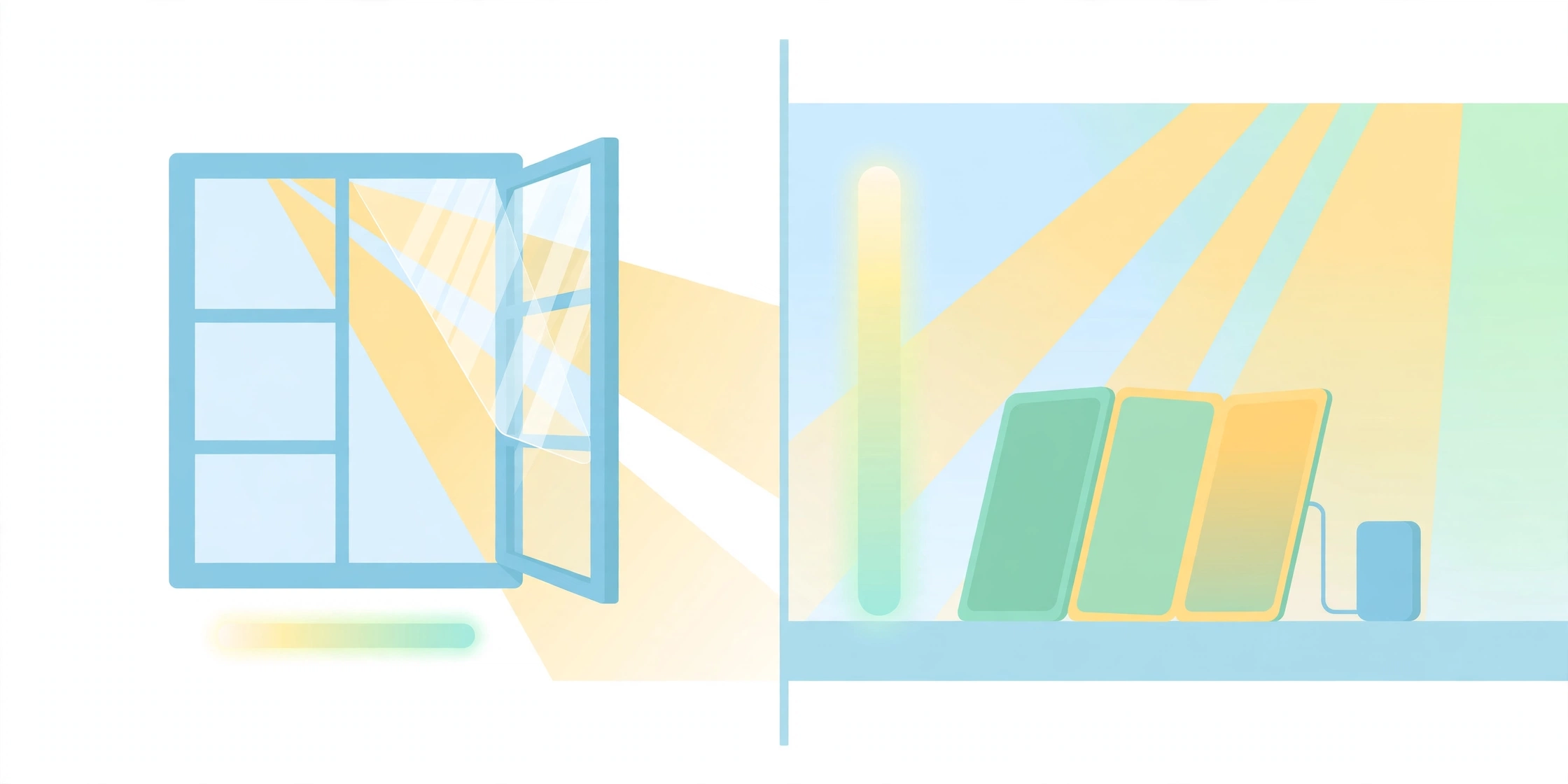
Compare that with a small 50-watt portable panel sitting on the same sill, angled toward the glass. It’s about a third of the window’s size. On a sunny day, it’d give you around 120 to 150 watt-hours, even with the glass in the way.
So a panel about a third of the size makes roughly double the power. And you can buy it today, plug it in and take it with you when you move. These are rough numbers, and your results will change with your window and the weather. But the gap is real.
What that power runs in daily life
Seventy watt-hours doesn’t sound like much, and it isn’t. On a good day it covers one full phone charge (about 15 watt-hours), a Wi-Fi router for around 3 hours (about 30) and an LED desk lamp for around 3 hours (about 24).That’s basically the whole budget. You’d be done by evening.
An air conditioner pulls 1,000 watts or more. An oven pulls 2,000 or more. Those would drain a day’s worth of window power in a minute or two. Don’t expect a window to run your apartment. It’s a phone charger with a nice view.
Why sun direction and floor level matter
Where you live changes everything here. If you’re in the US or UK, a south-facing window gets the most sun across the day. East and west windows get sun for a few hours. A north-facing window gets almost no direct light, so it’s a poor fit.
Floor level matters too. Picture a south-facing 5th floor apartment with a clear view of the sky. Nothing blocks the sun, so the window gets strong light from mid-morning until the afternoon.
A shaded ground-floor apartment with a tree outside and a building across the street is the opposite. That same window might get a third of the light, or less. Your numbers from the last section could drop to 20 or 30 watt-hours on a good day.
Before you spend any money on solar, check your window. Stand there at 10 am, noon and 3 pm. If the sun’s on your face for most of that, you’ve got something to work with. If you’re in shade, a window panel won’t help, and you’ll want a different setup.
What Does Transparent Solar Cost in 2026?
Cost breakdown and what changes the price
There’s no price tag you can look up, because you can’t really shop for this. Most of it is custom commercial work. Quotes come from contractors and glass makers.
Still, the ballpark numbers help. One industry guide puts current pricing at roughly $25 to $150 per square foot, which is about 2 to 4 times more per watt than regular panels. Another estimate says the glass alone starts around $5 to $26 per square foot, and the total after wiring and installation lands near $50 to $86. In the UK, one guide quotes about £250 per square meter. That wide spread tells you how young this market is.
A few things move the price up or down:
Glass type. Tinted glass costs less per watt than the clearest versions.
Window size. Bigger panes cost more, and odd sizes cost even more.
Installation. Wiring and an inverter add real money.
Building type. A new tower is easier than retrofitting an old building.
Custom work. Most jobs are one-off orders, which means no bulk discount.
Let’s do the math on a 1 square meter window, about 10.8 square feet. At $50 to $86 per square foot installed, that’s roughly $540 to $930. At the high end, it’s closer to $1,600. And what do you get? A window that makes maybe 70 watt-hours on a good day, like we worked out in the last section. That’s a lot of money for one phone charge and a few hours of router time.
Federal tax credit status in 2026
You might be hoping a tax credit softens the blow. Here’s where that stands.
The 30% homeowner credit is gone. The One Big Beautiful Bill Act, signed July 4, 2025, moved the end date to December 31, 2025. Under IRS guidance, you can’t claim it for property installed after that date, even if you paid for it before the deadline.
This credit is US only. If you’re in the UK, you can’t claim it.
Renters didn’t get much from it even before that. The credit was built for people who own their home and the system on it. If you rent an apartment and don’t own the windows, there was nothing for you to claim.
Building owners still have something. The business credit (Section 48E) applies to projects that began construction by July 4, 2026, or that are placed in service by December 31, 2027. It’s October 2026 now, so that first date has passed. A new project has to be finished by the end of 2027 to count. This helps a company putting solar glass on an office tower. It doesn’t help you.
Tax rules change, so check IRS.gov before you make any money decisions based on this.
What this means for a renter’s budget
For you, the cost picture is simple. There’s no paperwork and no waiting to see if a credit comes through. You pay once, and that’s it.
A small portable solar setup costs a fraction of one transparent window. Small portable panels are often in the range of $80 to $150, but prices move, so check before you buy. It also comes with you when you move. Transparent glass stays in the wall.
So if your budget is a few hundred dollars, spend it on something that works today. My guide to renter-friendly solar options shows which setups are worth the money.
What’s Coming Next for Transparent Solar (And When Renters Might Benefit)
Where the research is heading
A 12.3% efficiency record for a transparent solar cell came out of the EU-backed CitySolar project in 2025. The cell mixes organic material with perovskite and lets through about 30% of the light. Back in 2020, a University of Michigan team reached 8.1% efficiency with 43.3% transparency.
That sounds like a big jump. But remember the trade-off from the start of this post. A cell that’s 30% transparent isn’t clear glass. It’s tinted, and you’d see it. The fully clear versions still make much less power.
There are other hurdles too. Researchers say the main commercial challenge is balancing cost, looks and efficiency. The lead researcher in the CitySolar project also says funding is a barrier, because more research and testing is needed. Lifespan is another open question. Some of these materials wear out faster than a window should, since you don’t want to replace glass every few years. One EU project is working on exactly that, improving the stability of perovskite cells.
So the science is moving. But a record in a lab is a long way from a product on a shelf.
What to watch for in the next few years
I can’t give you a date, and anyone who does is guessing. But here’s what I’d keep an eye on.
Peel-and-stick films. This is the one that would matter most to you. A thin solar film you apply to your own window and remove when you move out would fit renting perfectly. Right now, it’s still early. If you see one for sale, use the checklist from the window films section: real watts, real test conditions and real reviews. I’d expect the first ones to make very little power, closer to a phone charger than a power plant.
Smart windows in new rental buildings. This is more likely to come first. Developers can build solar glass into a new building from day one, and the cost is much easier to spread across dozens of units. If you move into a new building in a few years, check whether it has any building-integrated solar. It’d be the building’s feature, not something you buy.
Plug-in balcony solar spreading. This isn’t transparent, but it’s the nearer win. More places are legalizing it. For many renters, this will matter well before any see-through window does.
A good habit: when you read a headline about a “breakthrough,” look for three things. Is there a price? Is there a product you can actually buy? And what’s the efficiency at the transparency level you’d want? If the article skips all three, it’s a research story, not a shopping story.
Should you wait or start now?

Start now.
Waiting for transparent windows means waiting for something you can’t buy, can’t install in a rental, and might not be able to for years. Meanwhile, a small setup works today.
A foldable panel and a power bank run roughly $100 to $250. It’ll charge your phone, earbuds and a lamp from day one. It folds up, so it works on a balcony, and it moves with you when your lease ends.
The payoff isn’t a big drop in your electric bill. A setup this size won’t do that. It pays off in other ways: free daily phone charging, a backup for when the power goes out, and a way to learn what your own sun hours can do. That’s real, and it starts the week you buy it.
And there’s no catch if better tech shows up later. A portable panel doesn’t lock you in. If a peel-and-stick film or a new plug-in kit works for you down the line, you can add it.
FAQs
Can I put transparent solar film on my rental window?
Not in any way that’s worth it today. Real transparent solar film isn’t sold to the public in a form that works for a home. The few things labeled “solar window film” online mostly block heat and don’t make power, or they make a tiny amount.
If a listing promises big watts from a clear film, be careful. Check the real efficiency and the test conditions. A film at 3% efficiency on a 1 square meter window gives you about 30 watts at perfect noon sun, and much less in real life. And even if you find a real one, check your lease first.
Do solar panels work through glass?
Yes, but they make less power. Glass blocks part of the light, and coated double glazing blocks more. Depending on your window, you can lose roughly 30 to 50% of the output, sometimes more.If you have a balcony, use it. If the window is your only choice, test a small panel first and see how fast it charges at noon.
Do renters get the federal solar tax credit?
No. The 30% homeowner credit ended on December 31, 2025, and it was built for people who own their home and the system on it. Most renters couldn’t use it even before that.Building owners can still claim a business credit for some projects, but that doesn’t help you. Tax rules change, so check IRS.gov if you want to be sure.
Is transparent solar worth waiting for?
I wouldn’t wait. The lab results are improving, but you can’t buy a rental-friendly version today, and I can’t promise a date.
A foldable panel and a power bank cost roughly $100 to $250 and work this week. If better tech shows up later, you can add it.
Final Thoughts: Know the Tech, Then Start Small
Here’s the short version:
A foldable panel and a power bank work today and cost around $100 to $250.Plug-in balcony kits can cut your bill, but only where the rules and your landlord allow it.
Check your sun hours, your lease and the safety rating before you buy.
Your next step is simple. This week, note when the sun hits your window or balcony on three different days. It costs nothing, and it’ll tell you which option is worth buying.