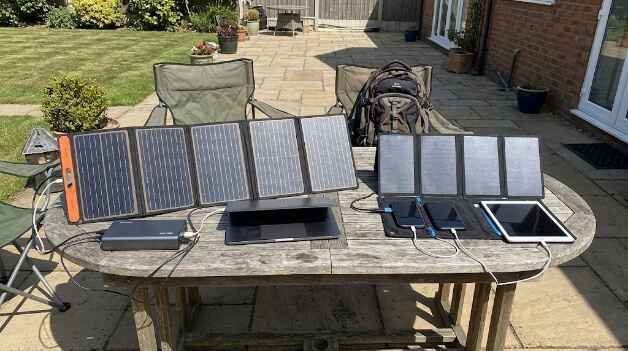
It happened on a Saturday. I was out on my apartment balcony, trying to squeeze in some sun before the afternoon clouds rolled in, and my phone hit 9%. No outlet in sight. Just me, a dying battery, and a half-written grocery list I really needed.
That's usually when people start googling solar chargers. Not because we're planning to live in the woods forever, but because basic real-life stuff happens—a weekend camping trip, a sudden load-shedding power cut, or just a balcony setup where dragging an extension cord through the window is a total headache.
Ready.gov, the U.S. government's official emergency preparedness site, points out that outages can disrupt more than just your lights — a full freezer will keep its temperature for about 48 hours, while a refrigerator only holds cold for around four. A small solar charger obviously isn't going to save your groceries, but it can keep your phone alive for calls, updates, or just checking how long the outage might last, which matters more than people think until they're actually sitting there with a dead screen.
So I got my hands on two chargers people keep asking about: the Flex Solar 60W and the BigBlue 28W. On paper, they look like they're built for different jobs. One's clearly the heavy lifter. The other is the grab-and-go option you toss in a backpack without thinking twice.
But specs on a product page don't tell you much. What actually matters is how they behave when you're standing outside, phone in hand, waiting for that battery icon to move.
Here's the short version of who each one is for. If you're charging a laptop, a power bank, or running something bigger during a camping trip, the Flex Solar 60W is built with more headroom. If you just need to keep a phone, some earbuds, or a small tablet alive during the day, the BigBlue 28W is lighter, smaller, and easier to live with.
This isn't the first time I've tested chargers on my own balcony either — I did a similar side-by-side test a while back with two different panels on my apartment window, and the results still shape how I evaluate these things today.
The rest of this post walks through how both actually performed — real sun, real clouds, real waiting around wondering if the panel was even doing anything.
The first thing you notice when you unfold the Flex Solar 60W is that it doesn't feel flimsy. A lot of budget solar panels have this thin, almost toy-like plastic feel to them, and you just know one bad fold and it's cracked. This one's different. The panel folds out into four sections, and each one has a sturdy, slightly rubbery coating that can take a scrape against a rock or a picnic table without you flinching.
Weight-wise, it's not something you'd casually toss into a small daypack. It sits somewhere in the range most people describe as "noticeable but manageable" — you feel it in your bag, but it's not throwing off your balance on a hike. It comes with its own zip-up carry case, which honestly makes a bigger difference than you'd expect. No case means loose panels bouncing around your trunk, picking up scratches and dust.
Setup takes maybe thirty seconds. Unfold it, prop it against your car window or a tent pole, and you're done. There are small loops on the corners for hanging it, which came in handy when I clipped mine to a fence at a campsite instead of laying it flat on the grass.
Here is where things get honest. I tested this on two very different days.
Day one was one of those bright, cloudless afternoons where the sun just sits there without mercy. I hooked up my laptop, which was sitting around 20%, and left the panel angled toward the sun on my balcony railing. In about two and a half hours, it climbed to 85%. That's genuinely solid for something you can fold up and carry in a backpack.
Day two was a different story. Overcast, that dull grey sky where you can't even tell where the sun is. Same laptop, same starting point. After two hours, it had only crawled up to around 45%. Not bad, but you could feel the difference — this panel really rewards you on sunny days and just gets by on cloudy ones.
That's the honest truth about most solar chargers, not just this one. According to NOAA's satellite research division, low clouds can block light from the sun, which means less solar energy — though certain cloudy conditions can actually increase the amount of light reaching solar panels. That lines up with what I saw: the panel slowed down on the overcast day, but it never fully stopped charging, and every now and then it seemed to catch a burst of light I couldn't even see with my own eyes. The higher wattage on the Flex Solar 60W gives it enough headroom to work with even when sunlight is scattered.
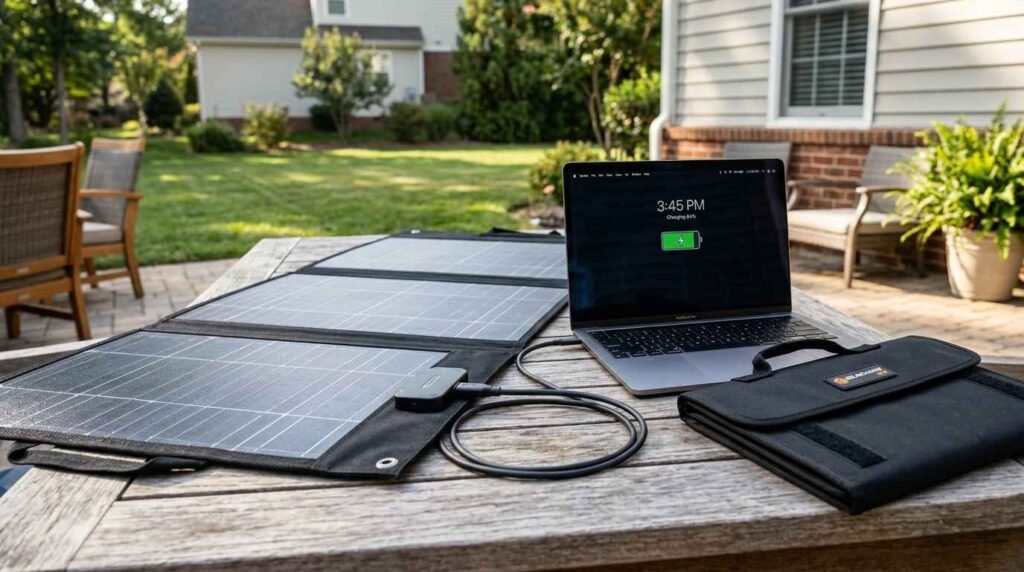
This charger makes the most sense for people who need real power output, not just a trickle charge. Van lifers who are running a laptop, a mini fridge, or charging multiple devices off a power station find this size worth the extra weight.
Campers who go for multi-day trips also benefit here, especially if there's a group involved — everyone's phone, a camera, maybe a drone battery, all pulling from the same source. And during power outages, which are becoming more common where I live, this is the kind of charger you want sitting in a closet, ready to keep essentials running instead of watching your phone die during an already stressful day.
Absolute lifesaver during unexpected power cuts when you need to keep essentials alive. Ready.gov, the U.S. government's official preparedness site, notes that people with medical devices powered by electricity should talk to their provider about a power outage plan. A solar charger obviously can't run a fridge or a medical device, but it can keep a phone charged enough to call for help, check outage updates, or stay in touch with family — which matters more than people realize until they're actually sitting in the dark.
If your charging needs are small — just a phone, maybe some earbuds — this panel is honestly more than you need. But for anything bigger, it earns its size and weight.
If a single charger like this isn't enough and you're thinking about a full backup setup for your apartment, I've covered how solar generators work for renters in both the US and UK in more detail separately.
The BigBlue 28W is the kind of charger you forget you're carrying, and that's a compliment. When folded, it's roughly the size of a small notebook, thin enough to slide into the front pocket of a backpack without eating up space you'd rather use for snacks or a water bottle.
I took it on a day hike a few weeks back, one of those trails where you're out for five or six hours and your phone is doing double duty — GPS, camera, texting someone to say you're running late. I clipped it to the outside of my bag using the built-in loops, and it just rode along, soaking up sun while I walked. No fuss, no thinking about it.
That's really the whole appeal here. It's not trying to be a powerhouse. It's trying to be the thing you don't mind having on you every single day, whether that's a hike, a bike ride, or just a walk to the park.
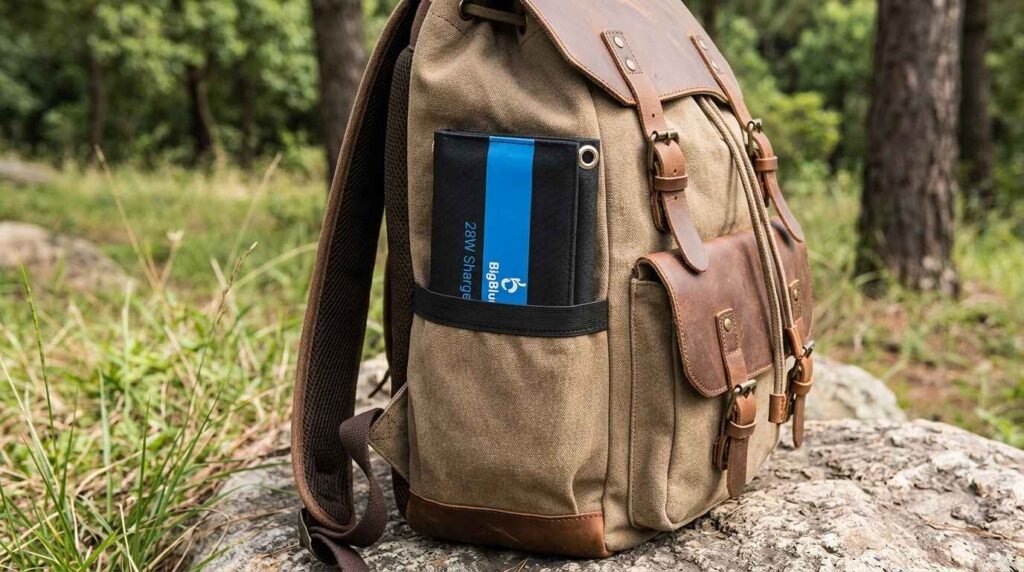
On that same hiking day, I ran a simple test. Phone started at 60%, earbuds case at about half. By the time I stopped for lunch around two hours in, the phone had climbed back to nearly full, and the earbuds case had topped off too.
Later that afternoon, I plugged my phone back in when it dropped to 40%, mostly from constant GPS use, and within about ninety minutes it was back near 80%. Over the course of the whole day, I charged my phone fully once and topped off the earbuds twice, all just from ambient sunlight while walking.
It's not going to touch a laptop in any meaningful way — I tried, out of curiosity, and it barely moved the needle. But for phones, earbuds, and small gadgets, it keeps up better than you'd expect from something this small.
This is the charger that makes sense for apartment living. If you've got a balcony that gets a few hours of direct sun, you can prop this up in the morning and have a topped-off phone by the time you're heading out the door.
If you're renting and your landlord isn't exactly thrilled about the idea of solar panels on the property, a portable charger like this sidesteps that conversation entirely — no installation, no drilling, nothing to ask permission for.
It's also the better pick for short outdoor trips — a day at the beach, a picnic, a quick weekend hike where you're not trying to run heavy electronics. And for anyone who just wants a backup in the glovebox or bag in case their phone or tablet dies unexpectedly, this is a low-hassle option that doesn't demand much space or attention.
If your daily needs are small, this charger quietly does its job without ever feeling like overkill.
If you're the type who needs to charge more than a phone, the wattage gap here matters a lot more than it looks on paper. But if your daily carry is just a phone and maybe a tablet, the BigBlue holds its own without asking you to lug around extra weight.
I wanted to see both panels side by side, not on separate days, but at the same time, under the same sky. So one morning I set both up on my balcony railing, angled the same way, phones at identical battery levels, and just let them run.
At 8 AM, the sky was clear. Both phones started at 30%. By 9 AM, the Flex Solar had pushed mine to 58%, while the BigBlue had the other phone at 50%. Not a huge gap yet, but you could already tell the 60W panel had more muscle behind it.
By 10 AM, clouds started rolling in, the kind that come and go without ever fully blocking the sun. The Flex Solar phone sat at 75%. The BigBlue phone was close behind at 68%. Still fairly even.
Then around 11 AM, the sky went properly grey for almost forty minutes. Both panels slowed down noticeably. The Flex Solar phone barely moved, up to 78%. The BigBlue phone actually kept pace better than expected, landing at 74%. That surprised me a little — smaller panels sometimes handle scattered light better simply because they need less to work with.
By early afternoon, once the sun came back out properly, the Flex Solar phone hit full charge first, right around 1 PM. The BigBlue phone followed about twenty minutes later.
So here's the honest takeaway. The Flex Solar 60W is faster, no argument there, especially under strong direct sun. But the difference in day-to-day phone charging isn't as dramatic as the wattage numbers suggest. Where the Flex Solar really pulls ahead is with bigger devices, not phones.
For a phone-only routine, the BigBlue felt more practical purely because of how little effort it took. No worrying about angle, no lugging it around. For anything beyond that, the Flex Solar earns its extra size.
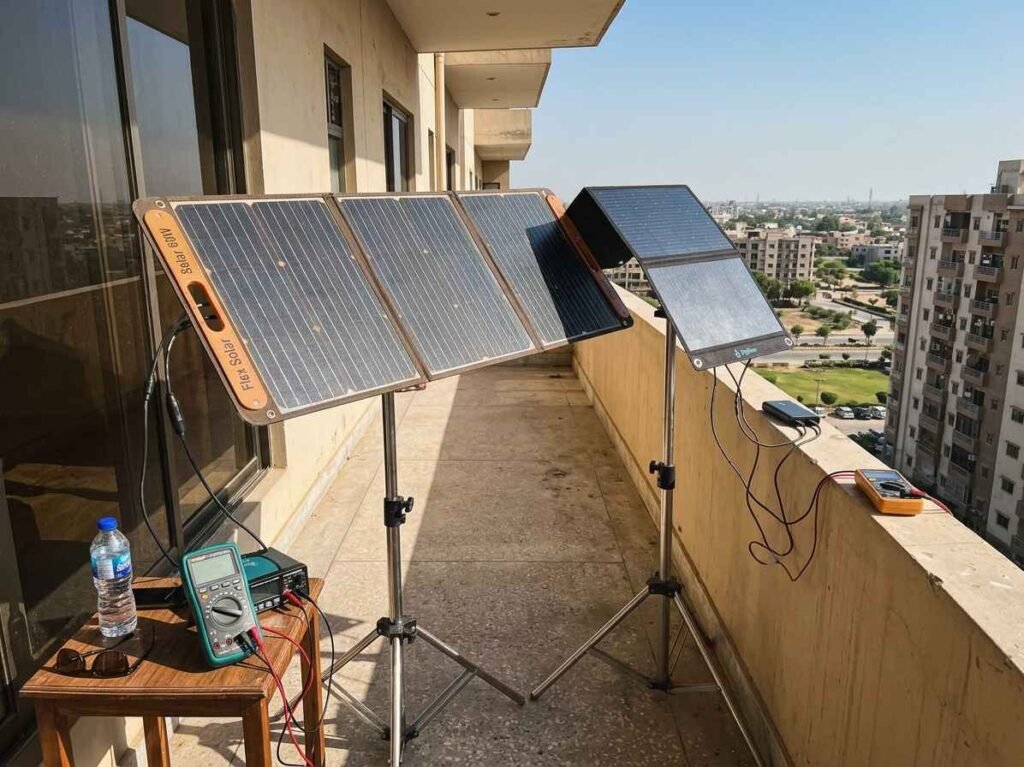
If your daily reality involves a laptop, a power station, or more than one device pulling power at once, this is the one to get. Van lifers, weekend campers who bring the whole family, or anyone who's tired of watching a power bank drain faster than it fills — the extra wattage genuinely earns its keep here. Yes, it's bulkier. Yes, it costs more. But if you've ever sat there watching a small panel struggle to keep up with a laptop, you already know why that trade-off is worth it.
If your charging needs start and end with a phone, some earbuds, maybe a small tablet, don't overspend on wattage you'll never use. The BigBlue does the job without asking you to think about it. It's the charger you leave in your bag and forget about until you actually need it, which honestly is the whole point.
At the end of the day, this comes down to a simple question: how much power do you actually need, versus how much are you willing to carry and spend? The Flex Solar 60W costs more and weighs more, but it can genuinely keep bigger devices running. The BigBlue 28W is cheaper, lighter, and covers everyday phone charging without any hassle. Neither one is the "better" charger overall. They're just built for different days.
If I had to boil this down to one line, it's this: buy based on what you actually carry, not what sounds impressive on a spec sheet. Campers and van lifers running bigger gear should lean toward the Flex Solar 60W.
Everyday phone users, hikers, and apartment balcony chargers will be happier with the BigBlue 28W.
Both did what they promised. Neither let me down when it mattered. The only real difference was how much power I actually needed that day.
Check current price of Flex Solar 60W on Amazon
Check current price of BigBlue28W on Amazon
Disclaimer: This post contains affiliate links. If you make a purchase through these links, I may earn a small commission at no extra cost to you. I only recommend products I truly believe in.